
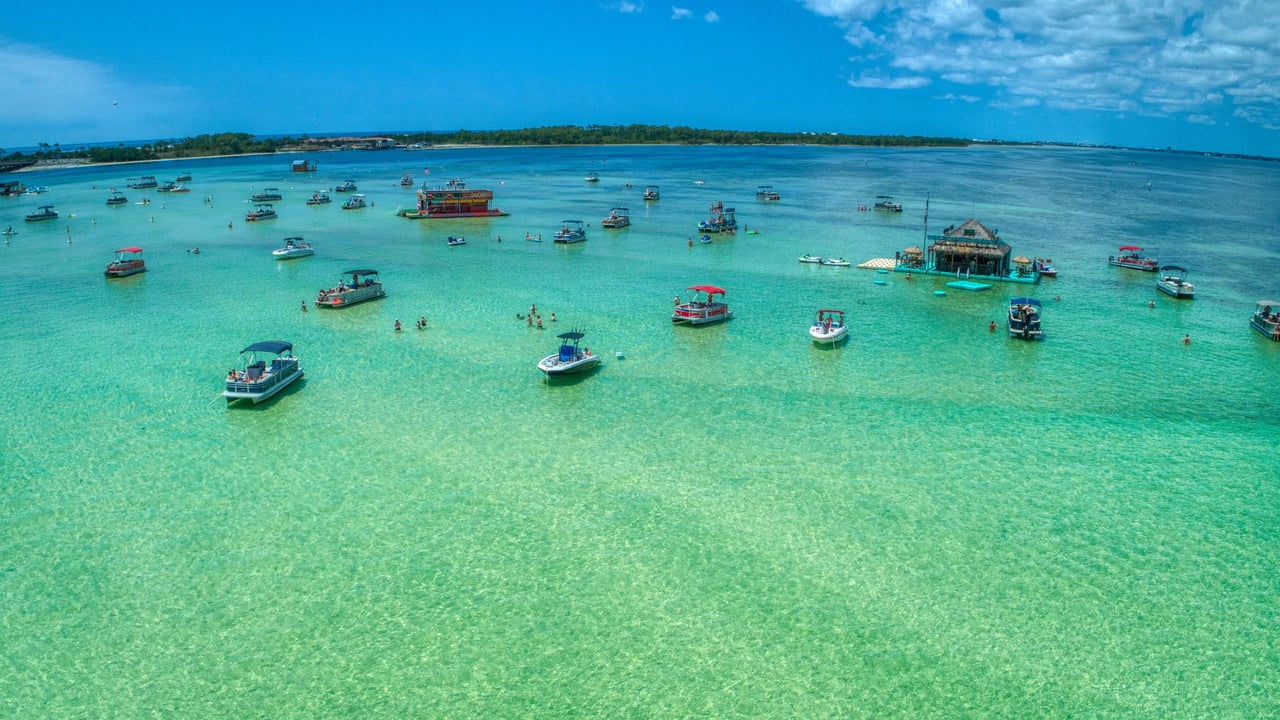
There is an hour in Destin before the beaches fill, before lunch orders begin hitting the kitchens along the harbor, before the afternoon boats point their bows toward the pass. The light comes up slowly over the water, catching outriggers and dock lines, turning the harbor silver for a few minutes while captains move across decks and engines begin their low morning hum. Somewhere, coffee is being poured into a cup that has probably made this trip a hundred times. Somewhere else, someone is checking the weather, the tide, the fuel and the Gulf beyond East Pass. Destin is waking up, but in many ways, the water never went to sleep.
This is the Destin that a postcard rarely explains.
For all the photographs of emerald water and sugar-white sand, Destin has never really been a beach town that happens to have a harbor. It is a water town, and that distinction matters when you begin to understand Destin luxury real estate, particularly the homes, condominiums and properties positioned along its harbor, canals, bayous and bayfront edges. Here, the water is not simply the scenery beyond the windows. It has shaped the economy, the traditions, the architecture, the rhythms of the day and, for generations, the way people have chosen where and how they want to live.
The story reaches back well before vacation rentals and waterfront restaurants. Destin traces its modern history to fisherman Leonard Destin, who settled in Northwest Florida around 1845 and whose family fished these waters for decades. The city’s relationship with East Pass, connecting the harbor to the Gulf of Mexico, helped establish the fishing culture that eventually grew into the charter fleet for which Destin is still known today. That history is not tucked away behind glass somewhere. It is still moving through the harbor every morning.
Perhaps that is why ownership here can feel different.
A person searching for Destin Florida homes for sale may begin with the same checklist used in almost any coastal market: bedrooms, square footage, views, finishes, outdoor living space. Then Destin quietly changes the questions. Can I keep my boat here? How quickly can I reach open water? What is the depth at the dock? What happens at low tide? Is there protected water nearby? Where does the afternoon sun land? Can I watch the boats come home from my terrace? Suddenly, the conversation is no longer just about the house. It is about the water around it and the life that water makes possible.
That difference becomes especially clear when considering Destin waterfront homes. There is waterfront, and then there is usable waterfront, a distinction experienced boaters understand almost instinctively. A beautiful view can be extraordinary, but a property with the right dockage, depth, positioning and access can change the way its owner uses the home entirely. The boat is no longer something stored somewhere else and retrieved for the weekend. It can become part of the architecture of daily life, waiting beyond the back door for an early run into the Gulf, an afternoon across Choctawhatchee Bay or an evening spent watching the last light disappear over the harbor.
And that is where Destin begins to separate itself from the idea of the traditional vacation home. For many buyers, the attraction is not simply having a property near the water. It is the possibility of organizing life around it.
A morning might begin with the sound of a boat leaving its slip rather than an alarm clock. The day can unfold according to weather and tide rather than reservations and itineraries. Family arrives and inevitably gravitates toward the dock. Someone decides the conditions are too good to stay home. Dinner comes back across East Pass in a cooler, or everyone heads toward the harbor as the charter fleet returns and the docks come alive again. This is not water as an amenity. It is water as infrastructure.
The harbor itself tells the story particularly well. Destin grew from a fishing village, and the working fleet remains part of the city's identity today. Local history records the progression from small fishing boats and seine nets to what became Florida's largest charter fishing fleet, preserving a culture that has survived even as the city around it has evolved. Modern Destin may include celebrated restaurants, new construction, waterfront estates, marinas and resort communities, but beneath all of it remains an unusually strong connection between land and sea.
That continuity carries into the real estate market in ways that are easy to overlook.
Coastlines cannot be manufactured. Harbor frontage cannot simply be added when demand increases. A canal lot with meaningful boating access cannot be reproduced three streets inland because the market suddenly wants another one. Waterfront real estate operates within a geography that imposes its own limits, and in established places like Destin, those limits become increasingly important. Scarcity is not merely about how many homes are listed for sale at a particular moment. It is about how many properties can ever possess the same combination of water, access, orientation, dockage and location.
Two homes with similar interiors may therefore tell completely different real estate stories.
One may offer an extraordinary Gulf view designed primarily to be experienced from the home itself. Another may sit along protected water with a private dock and quick access to the harbor. Another may place its owner directly on Choctawhatchee Bay, where the horizon broadens and the experience feels entirely different again. Each can be exceptional, but they are not interchangeable, and understanding those distinctions is one of the most important parts of purchasing waterfront real estate in Destin, Florida.
It is also why experienced buyers tend to become more specific the longer they look.
At first, the request may simply be "waterfront." Soon it becomes harborfront versus bayfront, private dock versus marina access, boating convenience versus Gulf panorama, new construction versus an established property in a location that may be exceedingly difficult to replicate. The prettiest kitchen can be renovated. Floors can change, pools can be redesigned and entire homes can be reimagined. Geography is far less cooperative.
There is another dimension to Destin real estate that cannot be measured quite so neatly, and that is legacy.
In coastal markets, certain homes become part of a family's calendar long before anyone thinks of them as an asset. They are where fishing stories become progressively less reliable with every retelling, where names and dates accumulate inside closets, where children learn which dock boards get hot in August and where everyone instinctively gathers when the sun begins to set. The home becomes a reference point. Birthdays happened here. Summers happened here. Thanksgiving moved here one year and somehow never moved back. What started as a real estate purchase slowly becomes part of the family vocabulary.
That emotional value is impossible to enter into a comparable-market analysis, yet it helps explain why some waterfront properties remain in families for generations and why opportunities in particularly desirable locations can feel so uncommon when they finally appear. Owners are not always deciding whether to sell a house. Sometimes they are deciding whether to close a chapter.
For sellers of distinctive Destin waterfront homes, that means the story of the property deserves to be understood alongside the statistics. Boat access, frontage, dockage, water depth, orientation, renovation history and physical condition all matter, but so does the property's place within the larger geography of Destin. A buyer should understand not only what is being offered, but why it may be difficult to find again.
For buyers, the same principle works in reverse. The most compelling property is not necessarily the one with the longest amenity list or the most dramatic photographs. It is the one whose relationship with the water aligns with the life they actually want to live. A serious offshore fisherman may evaluate a property through an entirely different lens than someone who wants broad sunset views across the bay. A buyer arriving with a substantial vessel will ask questions someone purchasing a Gulf-front condominium may never need to consider. The phrase "waterfront home" may fit both properties, but almost nothing about the ownership experience is the same.
That is why buying in Destin rewards curiosity.
Look beyond the view from the living room and study the water itself. Watch what happens in the harbor early in the morning. Notice the boats disappearing through East Pass and returning hours later. Spend time along the bay when the late afternoon light stretches across it. Understand where a property sits within this network of Gulf, harbor, bayou and bay, because those relationships often explain more about a home than the listing description ever could.
Destin has certainly changed since the days when Leonard Destin and his descendants worked these waters, yet there is something remarkable about how clearly the original thread remains visible. The boats are larger. The homes are more sophisticated. The harbor is busier. The skyline has changed. Yet morning still begins with people heading toward the Gulf, and evening still brings boats back through the pass as lights come on along the shoreline.
Perhaps that is Destin's real luxury.
Not simply the view, although the view can be spectacular. Not simply the house, although the right house can be extraordinary. It is the ability to belong to a place where the water still determines the rhythm, where ownership can stretch across generations, and where some of the most valuable properties are valuable precisely because what surrounds them cannot be recreated somewhere else.
The postcard gives you the emerald water. Destin gives you a life built around it. For guidance on waterfront and luxury property in Destin, begin with a private consultation with Corcoran Reverie.