
There was a time when buying a luxury home often came with an unspoken agreement. You would fall in love with the setting, admire the architecture, overlook a few eccentricities, and begin making a mental list before the inspection was even finished. The kitchen could be reworked. The primary bath needed an update. The windows might eventually need replacing. The screened porch was charming, although someone would need to determine whether it could survive an August storm. Today’s buyer is increasingly less interested in inheriting someone else’s list.
Across 30A, Northwest Florida, Franklin, Tennessee, and Greater Nashville, that shift is quietly reshaping the luxury market. Buyers are not simply searching for newer homes. They are searching for homes that feel resolved from the beginning, where the architecture, systems, technology, floor plan, and lifestyle all make sense together.
That is the real appeal of new construction. Luxury has always been associated with exceptional materials, beautiful settings, and thoughtful design. Increasingly, however, it is also being measured by something less visible: how little friction a home creates.
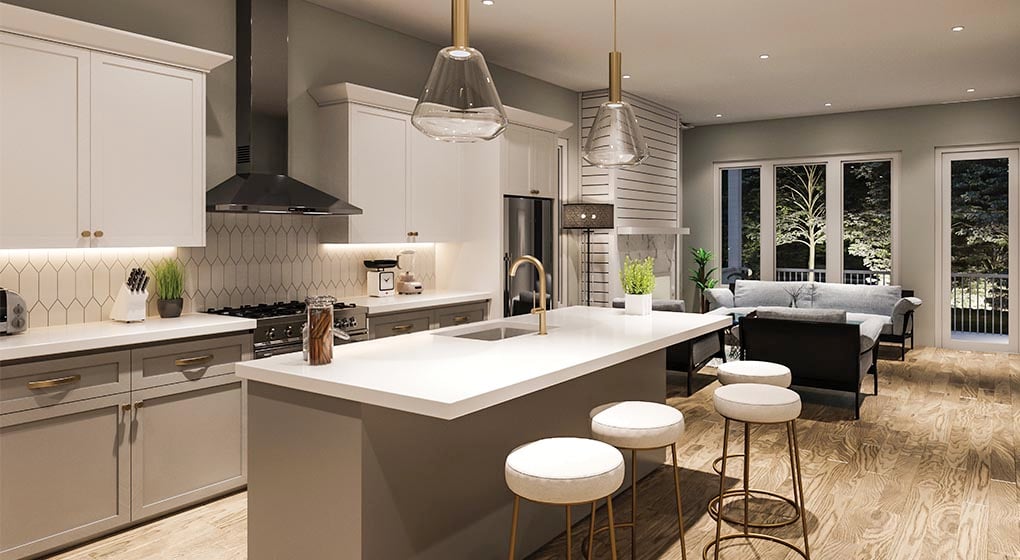
A well-designed new residence does not ask its owner to immediately begin fixing, adapting, or explaining it. The lighting feels considered. The kitchen belongs to the architecture rather than looking as though it arrived during a later renovation. The outdoor spaces are part of the home, not an accessory to it. Technology is integrated rather than retrofitted, and mechanical systems are current enough that the first year of ownership is not spent wondering what might need replacing next. That sense of ease has become enormously compelling.
When Buyers Stop Mentally Renovating
There is a particular moment during a property tour when a buyer realizes a home works. The conversation changes, instead of imagining walls coming down or cabinetry being repainted, they begin imagining people. This is where everyone would gather. The doors could stay open in October. Guests could have their own space. That office would actually work as an office. It is a subtle shift, but an important one. The buyer is no longer trying to make the property fit their life. They are beginning to see their life fitting naturally into the property.
Whether someone is looking at new construction homes on 30A, relocating to Franklin, Tennessee, or considering a newly developed community elsewhere in Florida or Middle Tennessee, buyers are placing greater value on homes that require fewer compromises from the outset.
That does not mean every buyer wants the same architecture, the same palette, or a pristine white box with excellent appliances and no discernible personality. Quite the opposite. The strongest new construction still has character. It simply has character without the plumbing project.
The Floor Plan Has Learned a Few Things
Homes have changed because the way people live has changed. The formal dining room is not necessarily gone, but it has been asked to justify its square footage. So has nearly every other room.
Today’s strongest floor plans are more fluid and more intentional. Kitchens have become genuine gathering spaces, while secondary living areas provide separation when a household needs it. Offices are designed as offices rather than hopeful corners carved out of bedrooms. Pantries, sculleries, mudrooms, laundry rooms, guest suites, and flexible spaces are no longer merely extras in many luxury homes. They are part of the architecture of everyday life.
The philosophy is the same in Florida and Tennessee, even when the homes themselves look completely different. Along the coast, indoor and outdoor living often blend almost completely. Great rooms open onto covered terraces. Kitchens flow naturally toward outdoor dining and entertaining areas. Pools are incorporated into the architecture rather than placed behind it. Storage is designed with beach equipment, bicycles, sandy towels, and a steady stream of guests in mind.
In Franklin and Greater Nashville, the landscape creates a different rhythm. Covered porches may frame rolling acreage or wooded views. Outdoor fireplaces extend the usefulness of terraces well beyond summer. Kitchens and living spaces often orient toward pools, gardens, or land, while garages, drop zones, and utility spaces accommodate households that may include children, guests, pets, hobbies, and more than one vehicle.
Different markets. Different architecture. The same expectation: the home should cooperate with the life happening inside it.
On 30A, the House Is Only Part of the Purchase
Nowhere is that idea more apparent than along 30A and the Northwest Florida coast, where buying a home often means buying into a very particular way of living. The property may begin with architecture, but the emotional picture is usually much larger. It is coffee on a porch before the rest of the house wakes up. Doors open to the Gulf breeze. Dinner outside after a day on the water. Bicycles leaning near the garage. Friends arriving for three nights and somehow staying for five.
Good new construction anticipates those moments instead of forcing the owner to engineer them later. That is especially important on 30A because the experience of one community can be entirely different from the next. Architectural identities vary. So do homesite sizes, rental considerations, amenities, ownership structures, and the relationship between a home and its surroundings.
A coastal residence may need durable exterior materials, thoughtful water management, generous outdoor living, and enough storage to keep the evidence of beach life from occupying the foyer. A home within a planned community may need to respond to a distinct architectural language. Elsewhere, privacy, larger lots, or views may drive every major design decision.
The best projects do more than place a beautiful house on a desirable piece of land. They understand where they are, and buyers can feel the difference.
Franklin’s Version of New Feels Entirely Different
Travel north to Franklin, Tennessee, and the expression changes, although the underlying desire does not. Here, new construction does not necessarily mean contemporary architecture. Some of the most compelling homes borrow from Tennessee’s architectural history without attempting to impersonate something built 150 years ago. Natural stone, brick, timber, generous porches, steep rooflines, and quieter palettes can create a sense of permanence while contemporary interiors support how people actually live today.
Getting that balance right is harder than it looks. Too much nostalgia and a new home can begin to feel theatrical. Too little connection to the surrounding landscape and it can feel as though it arrived by parachute. The strongest builders find the middle ground. They create homes with modern engineering, current technology, sophisticated interiors, and high-performance systems while allowing the architecture to feel grounded in the hills, trees, and open spaces of Middle Tennessee.
For relocating buyers especially, that can be a powerful proposition. They can have the character they associate with Franklin without necessarily inheriting decades of deferred maintenance along with it.
The Very Unsexy Luxury of Not Replacing Everything
No one has ever walked into a house and swooned over the age of the HVAC system. At least, not initially, but once due diligence begins, roofs, windows, electrical systems, plumbing, insulation, mechanical equipment, and exterior materials become considerably more interesting.
This is one of the places where new construction earns its appeal quietly. For many buyers, particularly second-home owners and people relocating from another market, newer systems create predictability. There is simply less history to investigate and often fewer immediate capital projects competing for attention after closing. Thatmatters in every market, but it can be particularly important when evaluating luxury new construction in Florida, where climate, humidity, salt air, storm exposure, drainage, and building materials all deserve serious consideration.
A beautifully renovated older home can absolutely be extraordinary. So can a historic residence with irreplaceable character. New construction is not automatically superior simply because the paint is fresh. But buyers are becoming more sophisticated about calculating the full cost of ownership, and that calculation increasingly includes time.
A home that requires years of projects has a price beyond the renovation budget.
Efficiency Finally Learned How to Be Beautiful
Energy efficiency once occupied a slightly awkward corner of the luxury conversation. Responsible? Certainly. Exciting? Perhaps not. That distinction has largely disappeared. High-performance windows, improved insulation, efficient HVAC systems, smart thermostats, LED lighting, tighter building envelopes, and increasingly sophisticated home technology can now operate almost invisibly within exceptional architecture.
Most buyers will never point toward a wall and become emotionally moved by its insulation. They will notice that the room is comfortable. They will appreciate being able to monitor systems remotely. They may value more consistent temperatures, reduced energy consumption, or technology designed into the home from the beginning rather than added years later with a collection of apps, adapters, and good intentions. For second-home owners, that becomes even more meaningful. A residence that can be monitored, managed, cooled, secured, and checked from another state removes an entire layer of anxiety from ownership.
That is a quieter form of luxury, but perhaps one of the most useful.
Why Some New Homes Simply Feel Better
There is another advantage to thoughtfully executed new construction that is more difficult to put on a feature sheet. Continuity. You feel it when the architecture and interiors speak the same language. When flooring transitions make sense. When hardware, cabinetry, stone, lighting, millwork, and fixtures feel as though they were chosen for the same house, in the same decade, by people who had met one another.
Nothing appears to have wandered in from another renovation. That visual continuity creates calm, and calm has become surprisingly valuable. After years of highly visible trends, dramatic renovations, and rooms sometimes designed as much for photographs as for people, many luxury buyers are gravitating toward greater restraint. They want craftsmanship rather than decoration. Materials rather than motifs. Homes that photograph beautifully, certainly, but live even better. The difference between a collection of expensive finishes and a beautifully designed residence is coherence.
Sophisticated buyers may not always use that word, but they recognize the feeling almost immediately.
New Development Is Also a Bet on What Comes Next
The appeal of new construction becomes even more layered when it is part of a larger development. Buyers may have the opportunity to enter a community while its identity is still taking shape, selecting a homesite with a particular orientation, choosing among floor plans or finish packages, or simply gaining an early understanding of how the surrounding neighborhood will evolve. For developers, this is where the story becomes inseparable from the real estate.
What will daily life feel like here? How does the architecture respond to the land? What makes this community distinct? What will still matter ten years from now, after the renderings, launch parties, and perfectly styled model homes have served their purpose?
Successful new development real estate is rarely just about selling inventory. It is about making the future tangible enough that a buyer can see themselves living in it. That requires more than good marketing. It requires a clear understanding of the market before the first residence is ever introduced.
New Does Not Automatically Mean Better
Of course, a completion date does not guarantee quality. A newly built home can still have an awkward floor plan. Expensive finishes can still be poorly chosen. A beautifully furnished model can distract from an inferior homesite. A development can photograph exceptionally well while offering a lifestyle that is completely wrong for a particular buyer. That is why new construction requires discernment, not simply enthusiasm. The conversation can involve builder reputation, warranties, finish allowances, change orders, architectural controls, development timelines, HOA structures, rental parameters, surrounding construction, future phases, and eventual resale positioning.
For buyers, the question is not merely whether the home is new. It is whether the home, builder, community, and long-term proposition make sense together. Developers face a version of the same challenge from the opposite direction. The strongest projects begin by understanding the buyer long before the first model opens.
What are buyers unwilling to compromise on? Which amenities meaningfully influence a decision? Which floor plans are resonating? Where are they willing to invest more, and which expensive features barely register? What already exists in the market, and where is there room to create something genuinely distinct?
Those are not simply marketing questions. They are development questions.
Where Market Intelligence Becomes Development Intelligence
At Corcoran Reverie, our work in new construction sits at the intersection of buyer behavior, real estate strategy, development, design, and market intelligence. That perspective matters because we see the conversation from both sides. We hear what buyers repeatedly ask for and where they hesitate. We see which features create emotional response and which ones simply increase construction costs. We watch buyers move between markets, comparing coastal Florida with Middle Tennessee, primary residences with second homes, and established communities with places that are still being built.
Those buyers may be purchasing very different lifestyles, but their underlying questions are remarkably similar. Does this home fit the way I want to live? Will it still make sense years from now? Am I buying quality, or simply buying new? And perhaps most importantly, what am I being asked to compromise on? Increasingly, the answer buyers want is simple.
The Luxury of Having Less to Fix
The appeal of new construction is not simply that everything is untouched. It is that everything had the opportunity to be considered together. The outlet is where you need it. The doors open toward the view. The pantry holds more than three cereal boxes and a blender. The outdoor space feels like part of the architecture. Technology works quietly in the background. The house understands that people entertain differently, work differently, travel differently, and live differently than they did twenty years ago. None of that needs to announce itself.
In fact, the best new construction rarely does. It simply works. And perhaps that is where the definition of luxury is moving. Not always toward more rooms, more ornament, or more spectacle, but toward homes that require less negotiation between what a buyer wants and what a property can actually deliver. Today’s buyers are not necessarily searching for more house. They are searching for fewer compromises.
When new construction is done exceptionally well, that may be its greatest luxury of all.
Considering New Construction in Florida or Tennessee?
Whether you are exploring new construction homes on 30A, considering a move to Franklin or Greater Nashville, or developing the next generation of residential real estate, the most valuable conversation often begins well before contracts, selections, or launch day.
Connect with Corcoran Reverie for informed guidance on new construction, new development, and the markets shaping what comes next.