
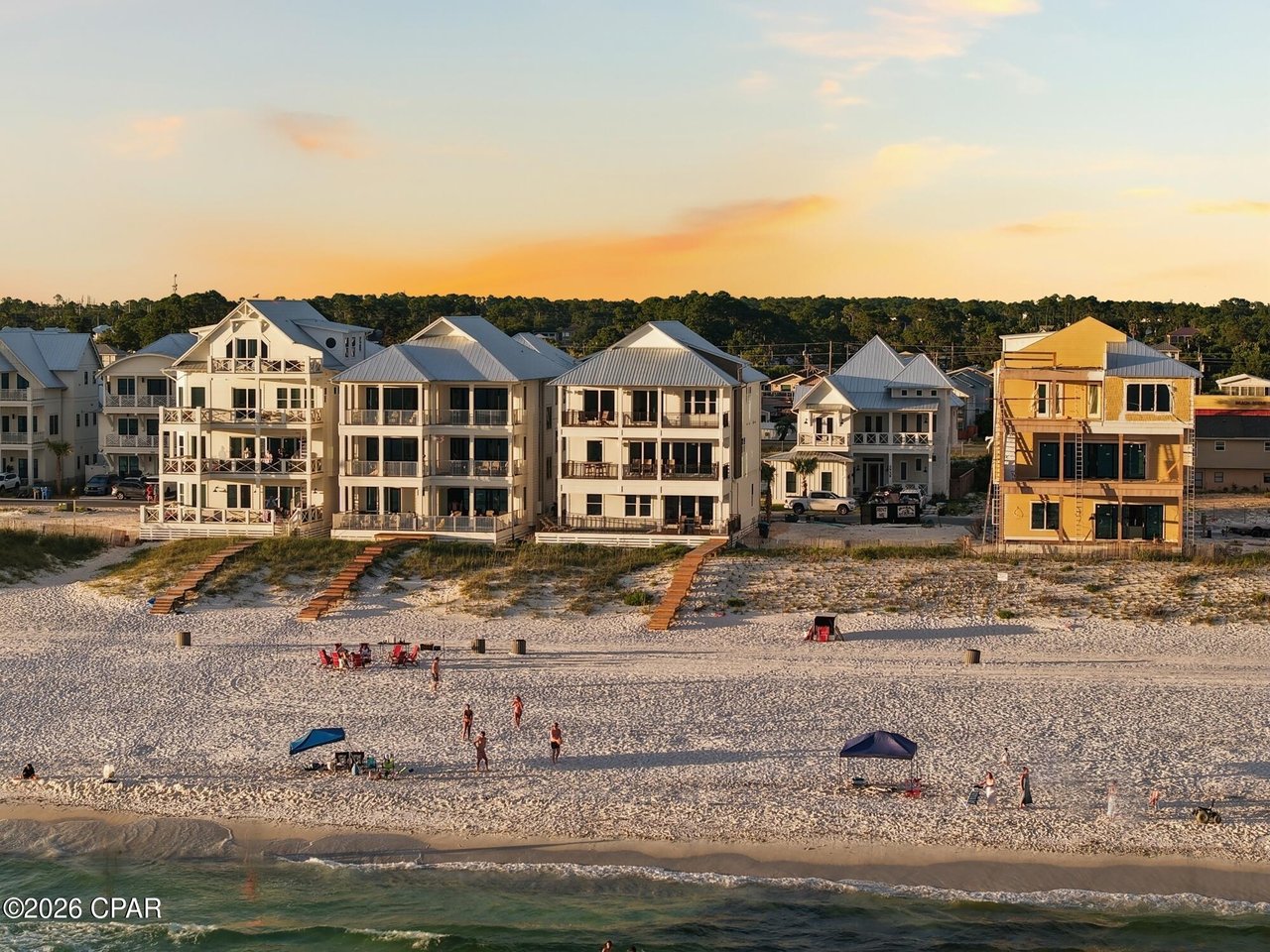
For generations of buyers, Panama City Beach has been easy to categorize. It was the place for Gulf-front condominiums, summer vacations, familiar restaurants and investment properties that filled with guests when school let out. Its identity was unmistakable, widely recognized and closely tied to the rhythms of tourism.
That Panama City Beach still exists. But it is no longer the whole story. Beyond the beachfront towers and vacation corridors, a more layered coastal market is emerging. New residential communities are expanding inland. National builders are introducing homes designed for longer-term ownership. Healthcare, transportation and public infrastructure are developing alongside the population. Buyers are arriving with different intentions, and developers are responding with a wider range of housing, amenities and community concepts.
Panama City Beach is not abandoning its history as a vacation destination. It is becoming something more complex: a coastal city where tourism, full-time living, second-home ownership, investment and long-range development increasingly overlap.
For anyone considering Panama City Beach real estate, that evolution matters. It changes how properties should be evaluated, how value may be created and why two homes only a few miles apart can behave very differently in the same market.
The Market Is Expanding Beyond the Shoreline
The Gulf remains Panama City Beach’s defining asset, but growth is no longer limited to the narrow strip of land closest to the water. Residential development is moving north and west, particularly around corridors connected to State Road 79, Panama City Beach Parkway, West Bay and the broader airport region. These areas provide something that established beachfront districts cannot easily create: available land.
That land allows developers to think at a different scale. Instead of a single condominium building or a small coastal subdivision, newer projects can include hundreds or even thousands of homes, neighborhood amenities, green space, retail connections and infrastructure planned around daily living. Communities such as Ward Creek, with new residential offerings from national builders, reflect the expansion of Panama City Beach new construction into more traditional primary-home and lifestyle-community formats.
This does not mean inland development competes directly with Gulf-front property. In many cases, it serves an entirely different buyer. A purchaser comparing a beachfront condominium with a new single-family home near West Bay is not simply choosing between two properties. They are choosing between two ownership experiences, two maintenance structures, two revenue models and often two very different definitions of coastal living. That distinction is becoming central to understanding the market.
New Construction Is Broadening the Buyer Pool
Historically, much of Panama City Beach real estate was built around the vacation economy. Condominiums, short-term rentals and second homes formed a substantial portion of the market’s identity. Today, PCB new construction is creating more options for people who want to live near the coast without purchasing directly on it.
Some are relocating permanently. Others are moving from nearby communities as their housing needs change. Some want a lower-maintenance second home that is not dependent on rental income. Others are drawn to new construction because they prefer current building standards, contemporary floor plans, energy efficiency or fewer immediate capital improvements.
The result is a broader buyer pool. Panama City Beach now serves investors calculating occupancy and revenue, second-home owners prioritizing ease of use, primary residents evaluating healthcare and daily convenience, and luxury buyers seeking privacy, design and access to the Gulf. Those groups may all be interested in the same geographic market, but they do not necessarily value the same things.
A property that performs exceptionally well as a short-term rental may not be the strongest fit for a full-time resident. A beautifully appointed new home may offer a compelling lifestyle but limited rental flexibility. A Gulf-front condominium may command a premium view while carrying insurance, reserve and association considerations that require careful review.
The market is becoming more sophisticated because the buyer questions are becoming more sophisticated.
Infrastructure Is Beginning to Support a More Permanent Population
One of the clearest signals of Panama City Beach’s evolution is the investment occurring outside residential construction. The broader Bay County population is approaching 200,000, with further growth projected over the coming decade. Economic development efforts increasingly position the region not only as a tourism destination, but also as a place to live, work and build businesses.
Healthcare is an especially important part of that shift. Florida State University, Tallahassee Memorial HealthCare and The St. Joe Company are advancing plans for an FSU Health hospital campus in Panama City Beach. The planned facility is expected to expand emergency, surgical, diagnostic and specialty care for residents across Bay and Walton counties. A hospital is not simply another construction project. It creates employment, supports surrounding commercial development and makes the area more viable for people considering permanent or extended residency.
Transportation and public improvements matter as well. The City of Panama City Beach continues work through the Front Beach Road Community Redevelopment Area, with projects intended to improve roadway systems, utilities, stormwater management and the public environment along major corridors. Northwest Florida Beaches International Airport has also changed the regional equation. Air access connects Panama City Beach more efficiently to major feeder markets and supports tourism, business travel, second-home ownership and relocation. Together, these investments suggest a market preparing for more than seasonal demand.
Tourism Is Not Disappearing. It Is Becoming More Year-Round.
It would be a mistake to interpret Panama City Beach’s growth as a move away from tourism. Tourism remains one of the market’s primary economic engines. What is changing is the way the destination is working to extend demand beyond the traditional summer calendar. Events, sports tourism, winter programming and shoulder-season travel are helping create activity across more months of the year. Visit Panama City Beach reported year-over-year tourism tax growth in November and December 2025, with fiscal-year collections also trending higher at that point in the reporting cycle.
For investors, this matters because the strongest opportunities may not be defined solely by peak-season occupancy. A property’s location relative to event venues, dining, recreation, marinas, public beach access and regional transportation can influence demand differently throughout the year. So can unit configuration, parking, rental restrictions, management quality and the condition of the surrounding property.
The phrase “Panama City Beach investment property” is therefore too broad to function as an investment thesis. One building may appeal primarily to families planning weeklong summer stays. Another may perform through events and group travel. A single-family home may attract multi-generational bookings. A property with limited rental flexibility may derive its value almost entirely from personal use and future resale. Buyers should understand the specific demand pattern for the property they are considering, not simply rely on the historic popularity of the destination.
Luxury in Panama City Beach Is Becoming More Defined
Panama City Beach has long contained luxury property, particularly in established communities such as Carillon Beach, Bay Point and select Gulf-front enclaves. What is changing is the level of attention now being paid to the upper end of the market.
A recent Carillon Beach property was positioned at $13.75 million, above the area’s previous reported residential sale record of $10.7 million. That does not establish a new value benchmark by itself, but it demonstrates that sellers and buyers are testing a higher ceiling for exceptional Panama City Beach luxury homes.
Luxury here is also becoming less synonymous with size alone. Buyers increasingly distinguish between a large vacation property and a truly differentiated coastal residence. Architecture, construction quality, privacy, water orientation, site scarcity, community planning and the long-term character of the surrounding area all influence how the upper end of the market perceives value.
The strongest luxury properties often possess something that cannot be easily replicated: direct Gulf frontage, protected views, meaningful acreage, deep-water access, established community identity or a highly limited homesite. As more new inventory enters the market, that distinction becomes more important. New does not automatically mean rare, and expensive does not automatically mean luxury.
Growth Does Not Make Every Property a Strong Investment
A growing market can create opportunity, but it can also encourage buyers to make overly broad assumptions. New development may strengthen a corridor, introduce amenities and improve the long-term visibility of an area. It may also create additional inventory, alter traffic patterns or place older properties in direct competition with newer homes. The relevant question is not simply whether Panama City Beach is growing. The better question is: How does this particular property fit within the direction of that growth?
For buyers, that means considering:
- What is planned nearby, and at what scale?
- Is the surrounding area primarily oriented toward tourism, permanent residency or a mixture of both?
- How much competing inventory may be delivered?
- What rental rules apply?
- Are major insurance, maintenance or association expenses likely?
- Does the property offer a feature that new construction cannot reproduce?
- Is the purchase dependent on appreciation, rental performance, personal use or a combination of the three?
Sellers should ask a different set of questions. Will buyers compare the property with newer construction? Does the home’s location outweigh its age or condition? Is the property being positioned for the correct buyer segment? Does its marketing explain why it belongs in the next chapter of Panama City Beach rather than the previous one?
Developers must think even further ahead. A successful project must account not only for current demand, but also for infrastructure, absorption, product type, insurance costs, buyer migration and the amount of similar inventory likely to enter the market before completion. Growth alone does not protect a poorly conceived project.
Panama City Beach Is Becoming a Collection of Submarkets
One of the most important things buyers should understand is that Panama City Beach does not operate as a single uniform market.
The West End does not behave exactly like the Pier Park corridor. Grand Lagoon has a different relationship to boating and recreation than a community near West Bay. A Gulf-front condominium has different value drivers from a newer inland home. Carillon Beach competes in a different luxury category than a high-density resort property farther east. Even within one neighborhood, rental rules, construction quality, view corridors, association management and distance from the Gulf can produce meaningful differences.
As the city expands, those distinctions are likely to become more pronounced. The phrase “Panama City Beach real estate” will continue to describe the market geographically. It will become less useful as a way to predict how an individual property should perform.
What Buyers Should Understand Before Entering the Market
Panama City Beach is growing up, but it is not becoming one thing. It is becoming many things at once. It remains a nationally recognized vacation destination. It is developing into a more permanent residential market. It is attracting large-scale community development. It is supporting more services and infrastructure. It is testing a higher luxury threshold. It is also continuing to offer investment properties whose performance is tied closely to tourism and property-specific operating realities.
That complexity is not a weakness. It is the source of the market’s opportunity. But it requires more precision. Buyers should not assume every new community will appreciate in the same way. Sellers should not assume historic demand will overcome condition or pricing. Investors should not assume proximity to the beach guarantees strong returns. Developers should not assume population growth will absorb any product placed in its path.
The next era of Panama City Beach will reward those who understand not only that the market is changing, but exactly where, how and for whom that change is occurring. Before buying, selling or developing in Panama City Beach, speak with a team that understands where the market is headed.